How To Start Analyzing Your Farm Business: SWOT Analysis Step by Step Guide 2026
How to Do a SWOT Analysis for Your Farm
Operating a successful farm takes more than good crop or healthy livestock management. One of the most effective tools for stronger decision making on the farm is a SWOT analysis. The farm and what surrounds it changes every day. Markets shift, prices fluctuate, weather impacts production, pressures from land use, and new opportunities emerge. Managing the farm as a profitable business requires making informed decisions, reviewing your farm plan from a broad perspective and making adjustments before the market forces change.
What is a SWOT analysis?
A SWOT analysis is an acronym for the following:
S: Strengths – What your farm does well
W: Weaknesses – Areas the farm could improve
O: Opportunities – New things that could grow the farm or improve profitability
T: Threats – External factors that could impact the farm
Farmers are business owners and a SWOT analysis gives you a structured way to evaluate both internal and external factors affecting your operation. Outlining these factors is not a way to make you feel like something is wrong; it’s an honest review of your current situation so that you can make better decisions around expansion, diversification, succession planning, purchases, labor, marketing, and risk management.
Why should a farmer conduct a SWOT analysis?
Producers are often focused on the day-to-day operations and struggle to build in time to step back and examine the big picture. A farmer should conduct a SWOT analysis in order to pause, reflect, and plan ahead. The benefits of a farm business SWOT analysis are:
- Better Decision Making: A SWOT can help farmers making major decisions based on facts rather than relying on instinct or trends
- Identify Competitive Advantages: Every farm has strengths that set it apart, whether prime farmland, strong reputation, established infrastructure, or proximity to markets
- Planning for Growth: When considering adding acreage, head of livestock, investing in a new enterprise, or expanding infrastructure, understanding the farm’s current position can help manage risk
- Preparing for Challenges: Identifying threats before they become problems can help with planning ahead and risk mitigation
What questions should a farmer ask during a SWOT analysis?
To get the most value from a SWOT analysis, farmers should ask questions that are honest and thorough. Consider asking for input from family, business partners, lenders and other advisors. Below are example questions to help during each stage of your SWOT analysis.
What are the strengths of my farming operation?
- What does your operation do well?
- What resources do you have that other farms or competitors do not?
- What are your most profitable enterprises?
- What are your strongest relationships (suppliers, landowners, lenders, etc.)
- What assets give you an advantage (land quality, ownership, facilities, technology)?
- What skills, experience, or expertise make you successful?
- What positive feedback do you receive from others?
Your answers might sound like: Prime farmland with strong yields, strong genetics for productive stock, excellent recordkeeping, strong customer base, updated equipment, skilled manager or mechanic
What are the weaknesses of my farming operation?
- What are your most consistent challenges?
- What processes are inefficient?
- Where are your gaps in expertise, marketing, labor, recordkeeping?
- Is equipment outdated or unreliable?
- Are you overly dependent on one source of income?
- What are your least profitable enterprises?
- What concerns have advisors or trusted peers raised?
- Can your farm withstand price decreases or down cycles?
Your answers might sound like: Unreliable equipment, limited recordkeeping, high debt load, limited marketing knowledge, lack of skilled labor, limited succession planning
What opportunities does my farming business have?
- Are there new markets in the area?
- Could you diversify in a way that complements current enterprises?
- Is there a new consumer trend that fits your operation or expertise?
- What new technology could improve efficiency?
- Could you use current equipment for additional custom work?
- Could you partner with other farmers or businesses?
- Is land around you available for lease or purchase?
Your answers might sound like: Custom application or harvest, direct-to-consumer sales, adding precision ag technology, value-added products, expanding acreage.
What threats could affect my farm?
- What market risks are most concerning?
- Are input costs increasing impacting profitability?
- What regulatory changes could impact your farm?
- Is labor becoming harder to find and keep?
- Are interest rates affecting borrowing costs?
- What impact is development having on the farm?
- Are you able to hold onto leased acres?
- Do you have a succession plan in place?
Your answers might sound like: Low commodity prices, trade volatility, drought or flooding, rising fertilizer prices, housing developments, high land prices, labor shortages.
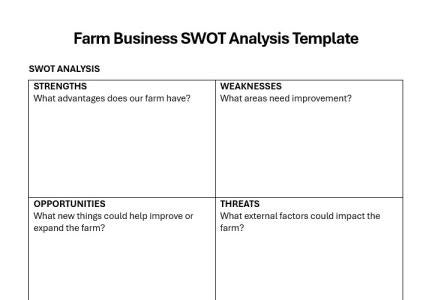
Download a SWOT Analysis Template
What do I do after a SWOT analysis?
Once your SWOT analysis is complete you should use the information to take action on your farm. This is where the boots meet the ground. Completing the SWOT analysis is an important first step but what you do after your complete your SWOT is just as important.
Ask yourself these questions to build an action plan
- How can we take advantage of our strengths to capitalize on opportunities?
- What weakness can we address first?
- What threat poses the greatest risk?
- Is there a threat that could be seen as an opportunity?
- What are some 12-month goals that you could set for your farm?
- What are some 5-year goals you could set for your farm?
After reviewing and reflecting on your analysis and asking yourself these questions, you should identify three to five priorities for the upcoming year. For each priority, you should list the action steps, your expected outcome, your target date for completion, and who is responsible for making sure the priority gets done.
What is an example of a farm SWOT analysis?
Having trouble understanding what a SWOT Analysis for your farm looks like? Lets say a family farm operates 50 cow-calf pairs and farms 800 acres of corn, soybeans and hay. The operation is evaluating how to improve profitability while preparing for their son to come back to the farm full-time and take on more management role. The farm is located one county over from a growing community with a new industrial park.
Example SWOT Analysis for a Farm
What are the strengths of my farming operation?
| What are the weaknesses of my farming operation?
|
What opportunities does my farming business have?
| What threats could affect my farm?
|
Example Action Plan for a Farm
Priority 1: Lease additional 200 acres to expand production
Action Steps:
- Analyze expected profitability of additional acres. Create business plan to show how taking on additional acres could support another operator
- Meet with the landowner to discuss lease agreement
Expected Outcome:
The additional acreage creates sufficient growth to support another family member in the business, improves economies of scale, and provides a clear pathway for the son to return to the farm.
Priority 2: Upgrade hay equipment to improve efficiency and reliability
Action Steps:
- Compare repair costs versus replacement costs over the next five years
- Evaluate replacement options for the baler and mower-conditioner
- Explore financing options and manufacturer incentives
Expected Outcome:
Newer equipment allows hay to be harvested more quickly during narrow weather windows, improves forage quality, reduces repair expenses, and provides greater reliability during peak season.
Priority 3: Evaluate the marketing plan for cattle and hay
Action Steps:
- Review historical cattle marketing performance and sale timing
- Compare selling calves at different weights or times of year to maximize profit
- Evaluate opportunities for direct marketing feeder cattle
- Explore selling hay based on quality rather than simply by bale
- Develop pricing goals
Expected Outcome:
A stronger marketing strategy helps the farm capture more value from existing production, improve price consistency, and increase overall profitability, rather than accepting what the market offers when ready to sell
Start your SWOT analysis with this template.
Our Opinion
The most successful farms aren’t necessarily the ones that avoid challenges. They are the ones that examine their position, adapt to change, and make intentional decisions about the future. We believe a farm SWOT analysis is a crucial tool in yearly farm planning.
Ricky Varnadoe, Relationship Manager at AgSouth Farm Credit in Walterboro, South Carolina has worked with many successful producers over the years. He shares,
“A SWOT analysis is an important tool every farmer or farm operation should use. It will help identify a farm’s strength, weakness, opportunities, and threats. This is a great tool to use when you are starting out or when you are looking at expanding your farm operation. It helps you put down on paper all risk and rewards of making changes to your operation.”
Whether you’re just getting started or managing a multi-generational farm, setting aside time to review your farm business with honesty can help you uncover risks, reveal opportunities, and guide you in developing a path forward. Evaluating your farm and planning for the future will lead to stronger decisions and a more resilient, sustainable business.